Base class for everything that lives in the scene. More...
#include <game_object.hpp>
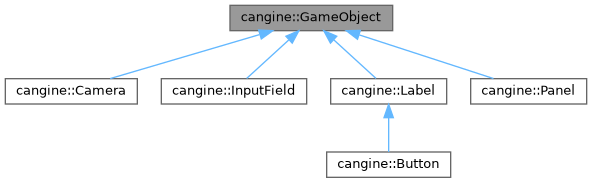
Public Member Functions | |
| GameObject () | |
| virtual | ~GameObject () |
| virtual void | onUpdate (double deltaTime) |
| Per-frame update hook. | |
| virtual void | onMouseEvent (const MouseEvent *e) |
| Mouse event hook. | |
| virtual void | onDisable () |
| Called when the object becomes inactive. | |
| virtual void | onEnable () |
| Called when the object becomes active. | |
| void | destroy () |
| Marks the object for destruction by the ObjectManager. | |
| template<typename T > | |
| void | appendComponent (T *component) |
| Attaches an existing component to this object. | |
| template<typename T > | |
| void | destroyComponent () |
| Destroys and removes the first component of a type. | |
| template<typename T > | |
| T * | getComponent () |
| Returns the first attached component of a type. | |
| template<typename T > | |
| std::vector< T * > | getComponents () |
| Returns all attached components of a type. | |
| template<typename T , typename... Args> | |
| T * | newComponent (Args &&... args) |
| Constructs a component in place and attaches it. | |
| void | setActive (bool a) |
| Activates or deactivates the object. | |
| bool | isActive () |
| Reports whether the object is active. | |
Private Attributes | |
| std::vector< IComponent * > | components |
| Components attached to this object. | |
| bool | pendingDestroy = false |
| Whether the object is queued for destruction. | |
| bool | active = true |
| Whether the object is active (updated/drawn). | |
Friends | |
| class | ObjectManager |
Detailed Description
Base class for everything that lives in the scene.
A game object is a container of IComponent instances. It exposes a type-safe component API (appendComponent, getComponent, newComponent, ...) and lifecycle hooks (onUpdate, onMouseEvent, onEnable, onDisable) that subclasses may override. Managed by the ObjectManager.
Constructor & Destructor Documentation
◆ GameObject()
| cangine::GameObject::GameObject | ( | ) |
◆ ~GameObject()
|
virtual |
Member Function Documentation
◆ appendComponent()
Attaches an existing component to this object.
Calls the component's IComponent::firstFrame once attached. Asserts if a unique component of the same type already exists.
- Template Parameters
-
T Component type.
- Parameters
-
component Component instance to attach (ownership taken).
◆ destroy()
|
inline |
Marks the object for destruction by the ObjectManager.
◆ destroyComponent()
Destroys and removes the first component of a type.
- Template Parameters
-
T Component type to remove.
◆ getComponent()
Returns the first attached component of a type.
- Template Parameters
-
T Component type to find.
- Returns
- Pointer to the component, or
nullptrif none.
◆ getComponents()
Returns all attached components of a type.
- Template Parameters
-
T Component type to find.
- Returns
- Vector of matching components (possibly empty).
◆ isActive()
| bool cangine::GameObject::isActive | ( | ) |
Reports whether the object is active.
- Returns
trueif active.
◆ newComponent()
Constructs a component in place and attaches it.
- Template Parameters
-
T Component type to create. Args Constructor argument types.
- Parameters
-
args Arguments forwarded to the component's constructor.
- Returns
- Pointer to the newly created component.
◆ onDisable()
Called when the object becomes inactive.
Reimplemented in cangine::Panel.
◆ onEnable()
Called when the object becomes active.
Reimplemented in cangine::Panel.
◆ onMouseEvent()
|
virtual |
Mouse event hook.
- Parameters
-
e The mouse event delivered to this object.
◆ onUpdate()
Per-frame update hook.
- Parameters
-
deltaTime Seconds elapsed since the previous frame.
◆ setActive()
Activates or deactivates the object.
- Parameters
-
a trueto enable,falseto disable.
Friends And Related Symbol Documentation
◆ ObjectManager
|
friend |
Member Data Documentation
◆ active
◆ components
|
private |
Components attached to this object.
◆ pendingDestroy
Whether the object is queued for destruction.
The documentation for this class was generated from the following files:
- cangine/src/cangine/engine/gameobjects/game_object.hpp
- cangine/src/cangine/engine/gameobjects/game_object.cpp